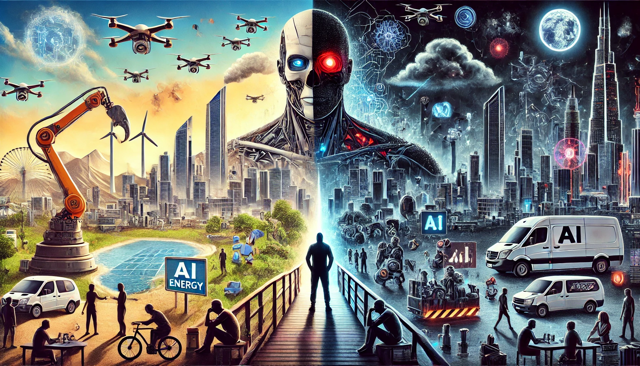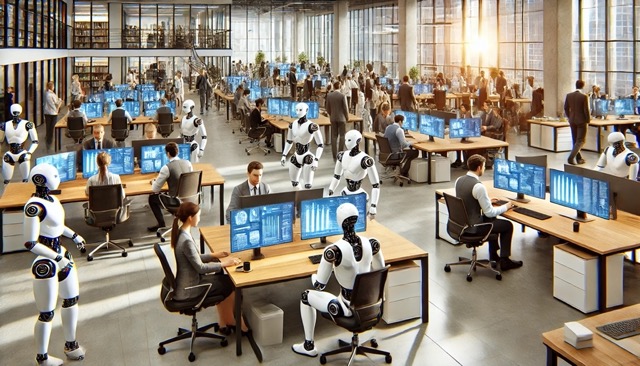
This question is weighing on the minds of more and more people these days. At first glance, the current job market appears solid—unemployment rates are at historic lows, and layoffs seem to have slowed. But if you talk to job seekers, you’ll hear a different story. According to a Forbes article, more than 70% of job hunters say the labor market is tougher than ever, with the average job search stretching to five months in 2024. Is this a sign of something bigger on the horizon? While AI might not be the sole culprit behind today’s hiring challenges, I believe we’re on the brink of a major disruption driven largely by the AI revolution.
In my introductory article, I discussed AI’s remarkable promises and equally serious risks to humanity. This time, I want to focus on one of the most pressing dangers: AI-driven automation and its potential to cause massive global job losses. This isn’t just the next phase of tech innovation; it concerns the future of a global workforce where hundreds of millions and potentially billions of jobs may, in a few years, hang in the balance.
A Double-Edged Sword: AI as Both Opportunity and Threat
There’s no more denying that AI is reshaping our world. Its capacity to stimulate economic growth and create new kinds of work is enormous. In fact, the World Economic Forum predicts that by 2025, AI will have displaced 85 million jobs but simultaneously created 97 million new ones—a net gain of 12 million jobs. AI could fuel worldwide economic expansion on a scale that surpasses both the Agricultural and Industrial Revolutions. As AI continues to evolve and spread, it will generate a host of new job categories requiring skill sets that fuse AI knowledge with specific industry expertise. Workers who rely on older, specialized skills alone might struggle to hold onto their positions.
This is reminiscent of what happened when Detroit’s auto industry was computerized, even employees with over 30 years of experience found it difficult to stay employed in a drastically transformed environment. With AI’s capabilities continuing to grow faster than ever, we should ask ourselves whether it will create enough jobs to offset those it destroys. And if there are enough new roles, will people be able to retrain quickly enough before AI automates the next wave of automation hits?
The Rising Capabilities of AI: From Automating Tasks to Surpassing Human Skills
AI’s current form, often called Narrow AI (NAI), already excels at repetitive tasks across industries such as warehousing, food service, data entry, customer support, and so on. In recent years, we’ve seen AI being used for more complex tasks, such as writing computer code and analyzing patient data, legal briefs, or financial statements. While we are still in the early stages of AI augmentation, these changes foreshadow how quickly AI is evolving.
In a recent interview, Facebook CEO, Marc Zuckenburg, stated that Facebook will release, in 2025, an AI software engineer with the skills of a mid-level software engineer. This highlights how quickly AI is encroaching on occupations once considered too complex for automation, pushing us to question which roles are truly secure.
As AI progresses from NAI to AGI (Artificial General Intelligence) and possibly ASI (Artificial Superintelligence), we could see a profound transformation of the job market. AGI refers to an AI that can do everything a human can do, while ASI is when it surpasses human abilities across the board. With 2025 being the year of “AI agents,” we’re moving from AI-powered tools to more autonomous software that uses foundation models to perform multi-step tasks. In other words, we’re transitioning from AI helping us think to AI taking action on our behalf.
Renowned futurist Ray Kurzweil, who has been impressively accurate in his AI predictions for more than 20 years, estimates that we could achieve Artificial General Intelligence (AGI) by 2029. Meanwhile, Sam Altman, CEO of OpenAI, envisions the next wave of AI mastering distinctly human abilities like creativity, critical thinking, and problem-solving. But if AI starts outperforming humans in these areas—faster, more cheaply, and with fewer mistakes—what does that mean for us?
We’re on the verge of what could be an exponential leap toward AGI, yet it’s tough for most people to grasp how fast this shift might happen. That’s because we naturally think in linear terms, while AI advances exponentially. If this trajectory continues, our world could change at a speed most of us can’t even fathom.
The Looming Job Crisis: Are New Jobs Enough?
AI’s exponential growth holds both enormous promise and serious risks. By 2026, we might see AI move from merely assisting us to flat-out outperforming us in a variety of tasks. This shift could transform entire industries and potentially displace millions of workers without offering enough new roles to fill the gap. Although many experts believe AI will create more jobs than it replaces, there’s also a real possibility that these new positions could become obsolete almost as soon as they emerge. Given how quickly AI is developing, you might find yourself retraining for a job that ends up automated soon after it hits the market.
In 2023, Alexander Sukharevsky, the global head of QuantumBlack (McKinsey’s AI division), claimed that 70% of current employee tasks could be automated by AI. This shift is already happening: TechCrunch notes that in 2024 alone, over 130,000 jobs were cut at 457 tech companies, including big names like Tesla, Amazon, and Google. Even smaller startups are feeling the heat. As AI takes over more tasks, the job pool available to humans will inevitably shrink.
When Elon Musk bought Twitter (now known as X) and slashed its workforce by 80% while still keeping the company operational, other CEOs paid close attention. As AI grows more advanced, companies can accomplish more with fewer people. Within the next three years, we’re likely to see multi-billion-dollar companies employing just a handful of human staff and depending mostly on AI-driven agents (autonomous software that handles complicated tasks with minimal oversight).
Emad Mostaque, a leader in the AI field, imagines this shift as the rise of a “new AI continent” filled with billions of agents. In this world, companies might employ AI “workers” who can match a college grad’s skill level at a price cheaper than a cup of coffee. And as AI, alongside robotics, excels at both cognitive and physical tasks, human workers may have a hard time competing.
Is AI Creating the Workforce of the Future or Replacing It?

At this point, it’s obvious that AI can handle and optimize tasks faster and more efficiently than humans in many fields. Yet some jobs might be slower to replace—like those that involve unpredictable physical labor (construction) or strategic management roles. However, quantum computing could further supercharge AI, meaning even these so-called “safe” jobs may not remain safe for long. Imagine a scenario in which robots handle building tasks while AI agents manage the logistics, design plans, and organize the entire construction process without much human help. This is no longer science fiction but a possibility.
Companies turning to AI in search of greater efficiency and cost savings isn’t inherently new, but the sweeping scale of it is unprecedented. It also prompts some tough questions about job security. For instance, roles we thought were untouchable in creative fields are also on the line. Sam Altman estimates that AGI could potentially handle up to 95% of marketing tasks. Meanwhile, Reid Hoffman (LinkedIn co-founder) expects that in three to five years, AI “co-pilots” will help us with everything from cooking dinner to making complex decisions. But what happens when these co-pilots become pilots?
It’s no longer a wild conspiracy to think humans could be out of work in many sectors. Avital Balwit, Chief of Staff to the CEO of Anthropic, admits she’s bracing for a time when her own job might vanish, saying, “These next five years might be the last few years that I work.” That’s a stark warning from someone deep inside the AI world, and she’s not alone. The looming changes may come in waves, sparing some industries temporarily. But given how fast AI is progressing, every field must prepare.
A WIRED article points out how tech professionals are actively training AI systems that might eventually replace them. Even though the shift won’t be instantaneous, certain jobs may be eradicated sooner than we think. Luckily, the transition to full automation will differ from industry to industry, some will take longer. Nonetheless, we can’t afford to ignore the warning signs.
Economic Boom or Human Replacement?
The potential for AI to spark an economic boom is massive. International Data Corporation (IDC) estimates that AI might contribute up to $19 trillion to the global economy by 2030. Hundreds of billions of dollars are being pledged to AI development The White House and tech leaders pledged up to $500 billion in AI investment in the US. OpenAI recently announced that “there’s an estimated $175 billion sitting in global funds awaiting investment in AI projects, and if the US doesn’t attract those funds, they will flow to China-backed projects.” There is no doubt that AI will create tremendous business opportunities, and we create many new kinds of jobs. Unfortunately, this upside also brings profound societal hurdles. If AI’s expansion continues in its current trajectory without proper guardrails, we risk mass unemployment, immense wealth gaps, social unrest, and mental health crises among displaced workers.
For now, the economy looks stable on paper, yet many job seekers are already struggling. What happens when AI grows even more dominant, and those economic indicators no longer tell the same story? Even Bill Gates has voiced worries about how disruptive AI can be, labeling it as the first technology with “no limits.” Paired with robotics, AI could potentially replace countless jobs in both white-collar and blue-collar sectors. While Gates also sees benefits, AI-powered tutors and healthcare assistants for underserved regions, even these supposed positives might reduce human job opportunities down the road.
Companies such as Boston Dynamics and Clone Robotics are striving to create humanoid robots that match human agility, dexterity, and, eventually, intelligence. We’re on the brink of a surge in humanoid robot integration into our lives. But how many jobs will remain for humans when tireless robots can outperform us in most tasks?
The Race to AGI: Are We Prepared for What’s Next?
As more money flows into AI development, the race among big tech companies to achieve AGI grows ever fiercer. This push doesn’t necessarily serve humanity’s best interests and could bring about severe consequences if we don’t urgently implement strong ethical frameworks. The global workforce could be the first casualty: according to Goldman Sachs, up to 300 million jobs might vanish by 2030 because of AI. Automation is no longer a distant worry; it’s quickly becoming our new reality.
One recent event underlines this point: a Business Insider article report revealed that Elon Musk’s new Department of Government Efficiency (DOGE) announced it canceled $420 million in government contracts within just 80 hours. This rapid outcome shows how quickly AI and automation-driven policies can disrupt sectors that once seemed unshakeable.
In the United States, a near-crisis with striking dockworkers fueled by fear of automation was averted last in late 2024. In the tech industry, meanwhile, layoffs keep piling up because companies are leaning into an AI-driven future. While some, like Graham Allen, predict that job loss from AI might roll out gradually, others see it happening so fast it could catch entire industries off-guard—especially as autonomous AI agents grow more advanced.
Elon Musk and Vivek Ramaswamy stepping in to lead DOGE could lead to large-scale government staffing cuts in favor of AI systems. Like they say, “As the U.S. goes, so goes the rest of the world.” If this trend gains momentum, other governments and industries might follow suit.
Can We Prepare for the Future Workforce?
AI will revolutionize how we work and likely create new job categories. But will it generate enough roles to replace those it renders obsolete? And even if these new positions exist, can people learn the necessary skills quickly enough? If AI continues evolving at its current pace, the realistic answer to both questions might be a resounding “no.”
This shift reflects a broader quest for better efficiency and cost-cutting, which does bring innovation and productivity. However, it also raises major questions about job security, especially for workers in more traditional roles.
The risk AI poses to the job market is significant, and we don’t want to be caught off guard like when COVID-19 upended the world. Governments and businesses must collaborate to develop more rigorous ethical guidelines and safety measures to protect workers in this new, AI-driven labor era.
A Call to Action: Slowing Down or Prepare for an AI Tsunami
For everyday people, it’s increasingly important to understand AI fundamentals. Gaining even a basic familiarity with AI tools and pairing that with your current expertise might offer some resilience against job losses. In the long run, roles involving unpredictable physical tasks, people management, or highly specialized skills may stick around the longest, though not indefinitely.
Still, unless companies and governments take serious steps to regulate AI’s progress, we could face an irreversible crisis, one marked by extreme unemployment, poverty, inequality, social unrest, and the disempowerment of entire generations. AI’s promise is tremendous, but so are its dangers. Ilya Sutskever (former co-founder of OpenAI) made the following statement “The way I think about AI of the future is not as someone as smart as you or as smart as me, but as an automated organization” Its constituent AIs would work and communicate at high speed, like bees in a hive. A single such AI organization would be as powerful as 50 Apples or Googles.” Now, imagine a world filled with billions of such entities—how could humanity possibly keep up or stay in control? This glimpse into our possible future should send chills down our spines and prompt us to reflect deeply.
Time is running short. We must either slow down or pause to strike the right balance between innovation and caution. The future of work—and perhaps the very future of humanity—depends on how we decide to act today.
The time to act is now. To ensure that AI enhances human potential rather than replacing it, we must slow down or pause to find a balance between innovation and caution because the future of work, and perhaps the future of humanity, depends on it.